
Explore the sky
Browse observations of a field and compare images from different epochs.
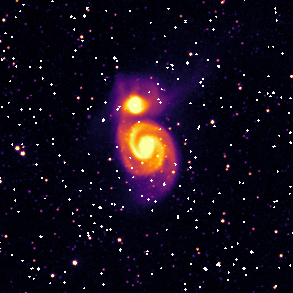
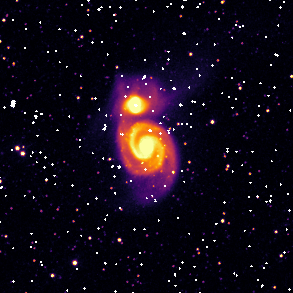
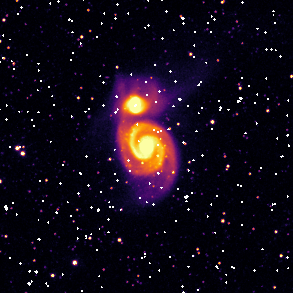
Cutouts from the same detector use the same brightness scale across epochs.
About this target
The Whirlpool Galaxy is a face-on spiral. Its smaller companion, NGC 5195, appears next to the main galaxy.
What to compare
Use the two bright centers as landmarks. Check whether the faint glow around the larger galaxy keeps the same shape before interpreting any brightness differences.
Compare cutouts side by side
First and last epochs from the same detector, using the same brightness scale. Compare only the area observed in both cutouts.
Fun fact
The smaller galaxy may help shape the Whirlpool’s conspicuous spiral arms, where many new stars form.
Source: NASA · HubbleDouble-click or pinch to zoom. Drag the zoomed image or use the arrow keys to move it.
Swipe horizontally or use ← → in the viewer to switch images.The moment a picture of the sky was taken. Comparing different epochs reveals what moved or changed brightness.
Source and processing
- Observation
- May 16, 2026, 5:35:49 AM UTC
- Collection and detector
- spherex_qr3 · D2
- Detector bandThe "color" of light. SPHEREx sees infrared, invisible to the human eye, measured in micrometers (µm).
- 1.3766 µm · width 0.5466 µm
- Observation ID
- 2026W20_2A_0275_1
- Retrieved
- —
- Processing
- NASA/JPL-Caltech/IPAC · SPHEREx via IRSA · r1 · Nov 15, 2026, 3:11:50 PM UTC
Loading the orbit view…